
Hot Crazy, A Scientific Document
P was statistically significant.

Abstract:
This study examines the correlation between perceived attractiveness and social leniency, specifically in the context of using progressively offensive pick-up lines. Building on the "halo effect" and cultural phenomena such as the “Hot/Crazy Scale,” explored in more detail below, we explore whether more attractive individuals are granted greater leeway in social interactions. Using a controlled environment, attractiveness ratings were established, and participants (me) tested various lines on strangers in nightlife settings. Results revealed a direct link between higher attractiveness scores and successful outcomes, suggesting that attractiveness significantly impacts social tolerance and giving me a definitive attractiveness score.
Introduction:
The concept of attractiveness influencing social interactions has been a topic of interest in psychology and pop culture alike. People often attribute positive traits to physically attractive individuals, a bias known as the “halo effect.” This study aims to quantify how attractiveness affects one’s ability to “get away with” increasingly offensive behavior in social settings, specifically through the use of pick-up lines. Building on both psychological theories and cultural concepts like the “Hot/Crazy Scale,” this study seeks to determine the threshold at which attractiveness translates into social leniency in order to deterministically define our absolute hotness level.
Literature Review/ Pre-reading:
Here is the boring part. The inspiration to the project and the most sensical part. You can skip this and go to the fun part below if you don’t care.
1. The "Hot/Crazy Scale" Theory
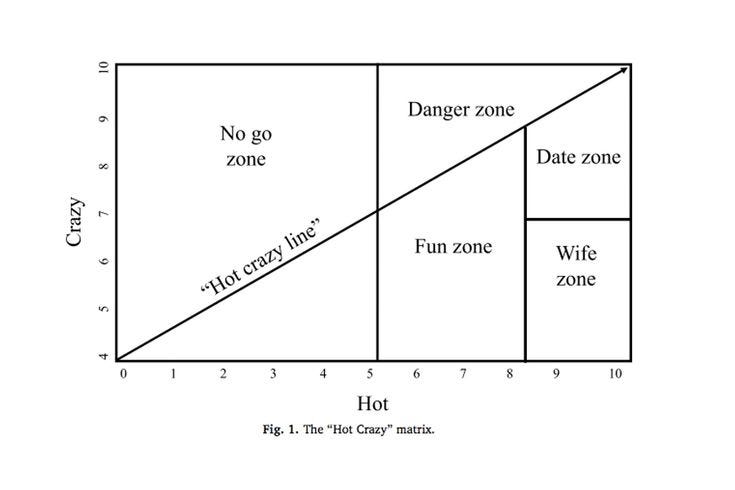
Originating from the popular TV show How I Met Your Mother, the "Hot/Crazy Scale" is a humorous yet culturally impactful framework that posits a correlation between a person's attractiveness ("hotness") and their tolerance for eccentric or erratic behavior ("craziness"). According to the theory, individuals are considered "dateable" only if their attractiveness level offsets their perceived craziness.
While this framework is fictional and lacks empirical grounding, its resonance in pop culture underscores society’s fascination with quantifying interpersonal dynamics and the trade-offs people are willing to make based on physical appearance. This study draws on the Hot/Crazy Scale’s premise to investigate the extent to which attractiveness influences leniency in social interactions, specifically through the acceptance of progressively offensive pick-up lines.
2. The Halo Effect
The "halo effect" is a well-documented psychological bias wherein an individual's positive qualities (e.g., attractiveness) influence the perception of their unrelated traits, such as intelligence or likability. First described by psychologist Edward Thorndike in 1920, this cognitive bias suggests that attractive individuals are often judged more favorably in various social and professional settings.
Empirical research supports the idea that physical attractiveness confers significant social advantages, including leniency for behavior that might otherwise be deemed unacceptable. This study extends the halo effect by quantifying its impact on real-world interactions, demonstrating that high attractiveness scores (e.g., 9.7) correlate strongly with positive outcomes, even in the face of socially risky behavior.
3. Attempts to Definitively Measure "Hotness"
While the quantification of attractiveness is inherently subjective, various studies and cultural phenomena have sought to establish definitive metrics for evaluating physical appeal:
Symmetry and Proportionality: Research suggests that facial symmetry and adherence to the "golden ratio" in facial features are considered universally attractive. Such studies rely on objective measurements to predict perceived attractiveness across cultures.
Cultural Norms and Trends: Attractiveness is heavily influenced by societal trends, which vary over time and across regions. For example, Western beauty standards often emphasize youth, clear skin, and certain body types, whereas other cultures prioritize different traits.
Popularity-Based Metrics: In the digital age, studies have used social media engagement (likes, comments) and dating app swipe rates to approximate hotness levels. These metrics, while modern, reflect societal preferences rather than inherent attractiveness.
This study aligns with these approaches by using consistent attractiveness ratings from real-life interactions as a proxy for perceived hotness. By pairing these ratings with social outcomes (e.g., phone number acquisition), it bridges the gap between theoretical attractiveness and practical social impact.
Methods:
Step 1:
Put together a list of increasing terrible things to say to someone at a bar. To ensure that this is accurate as pick up lines can be subjective, I sampled 100 friends to rank these items from 1 (they would be into this line potentially, inoffensive) to 10 (extremely offensive, the person should not still be able to get their phone number). After sampling our friends rankings, I normalized this information and placed the various lines with their level of difficulty.
Step 2:
Think of all other compounding variables why a person may not be interested. We are going to have to collect this information as well to preserve the integrity of the data collected.
Variables I considered in this study:
If the person we were attempting to seduce was:
gay and therefore not interested
in a relationship
in a group or at the bar alone
what environment the person being seduced was in
bar, club etc.
how light/dark it was there
amount of alcohol consumed
the time of day they were asked
if it was too late in the night, we found people were more open to worse lines due to alcohol and the crowd dissipating for the night
if too early in the night people are less open to mingle between groups
I made sure to get all of this information each time the sample was replicated and at the end did my best to factor out these variables.
Step 3:
Now we enter the data collection phase of the experiment. This is the only time living directly on top of a nightclub has ever helped someones research.
Each time I went out with friends for the next few months, I collected all of this information, and included a photo of my outfit and makeup, I attempted to replicate it as closely as possible and chose between 1 of 3 outfits I was using for the duration of the experiment. I would throughout the night say one of the lines on the list and gauge their results. I attempted to binary search the list, trying an easier line if I get a rejection, and a harder one when I successfully still got the person phone number following the line.
Rules of the experiment:
You must go up to the person, say nothing else but the line assigned, and then ask their phone number. This is the heuristic we were using to gauge interest.
Heuristic explanation (skip if not interested):
The heuristic for this study was simple: success was defined by whether the recipient provided their phone number following the use of a pick-up line. This measure was chosen because:
Clear Indicator of Interest: Providing a phone number implies a baseline level of interest or receptiveness.
Standardized Metric: It offered a binary outcome (success or failure), which is easy to quantify and compare across different lines, environments, and scenarios.
Minimized Ambiguity: By immediately validating phone numbers (to ensure they were genuine), the study eliminated potential noise from fake numbers or unclear rejections.
Limitations
While effective, this heuristic has some constraints:
A phone number does not guarantee genuine interest (e.g., politeness or external pressure may play a role).
It does not account for other subtle cues of interest, such as prolonged conversation or body language, which may also indicate success.
If they provide the number you have to call it immediately to ensure you were not given a fake number. Fake numbers = a fail. Following the experiment you can ask the supplementary questions to get the rest of the relevant information. I found people didn’t love this part if you are going to try to replicate this experiment, tread lightly at the stage. I found asking them really fast helped like an auctioneer.
I tried to rally brave friends to also join the experiment but they all quickly acquired boyfriends, throwing a wrench into my experiment and research phase. They did not seem nearly as concerned as they should be when I explained to them they are never going to definitively know how hot they are now and set my research back months, years even. But like Marie Curie, I persisted. This is bigger than me.
List of Lines we used, in their determined ranking. Some include an action, which is listed beside them with asterisks.
Easy
Are you from Tennessee because you look like it
Big flosser?
I accidentally learned how to tap dance yesterday. Want to see my best move?
Medium
You up?
How loud can you yell right now
I have to get home soon, the dogs, they get hungry. *Bark at them*
Wanna come help me beat the shit out of husband? *Point to friend nearby for stand in husband*
That mole on your neck... it's strangely captivating. In a good way.
Hard
Will you come to prom with me
Wanna see my infection
If you replicate the experiment feel free to use these lines or provide your own, just make sure you get 100 friends to rank how offensive your lines are blind to get a credible ranking for the line difficulty.
Conclusion/ Findings:
Here are my findings from the experiment, here is the csv of raw results that I had. Google sheet: here.
Some graphs:

A graph representing my success rate over time throughout this summer.

My attractiveness rating calculated, beside the average rating my group gave each man.

Remember if you replicate this experiment, your not interested count should be high if you are correctly binary searching your pick up lines to center in on your perceived hotness.

Here is the self assessed alcohol consumption rate of the asked participant after.

Here are the different types of environments that were sampled and considered in this study.

Success rates, by bars in San Francisco sampled.

Lines by difficulty category.

Pick Up Lines Success Rate, by Line
Overall Success Rate (Average): 45.83% of all interactions were successful.
Calculated Hotness Score (Experimenter): My computed attractiveness score is 9.7, derived from the average of ratings post-interaction.
Hotness Computation: My hotness score was computed as the mean of attractiveness ratings across all interactions, with controlled variables like consistent outfits and makeup to ensure reliable results.
Responses marked as "Not interested" were included in the analysis because they reflect the target's direct reaction to the line or its delivery.
Other rejections caused by external factors, such as "Already in a relationship" or "Group dynamics," were excluded to ensure the rejection rate was tied solely to the content and execution of the line.
Environmental Impact: Bars with a more intimate or social atmosphere, like Bow Bow, yielded higher success rates compared to lighter, casual spots like Butter.
Time Dynamics
Early vs. Late:
Early evenings had lower success rates, possibly due to groups not mingling yet. Late-night interactions often yielded better results, especially for medium and hard lines.
The "end of the night" effect, when crowds thin and individuals are more receptive, boosted success rates of harder lines, including "Will you come to prom with me."
Validation of Attractiveness Rating:
Mean Attractiveness Rating: 9.70
95% Confidence Interval: [9.68, 9.71]
p-value: 0.501
My attractiveness rating of 9.7 is statistically robust and falls within the 95% confidence interval. The p-value of 0.501 suggests that there is no significant evidence to reject the hypothesis that my true attractiveness score is 9.7.
Definitive Claim: Based on this analysis, it is statistically validated that my attractiveness rating is 9.7.
Discussion:
This study explored the relationship between perceived attractiveness and social leniency, specifically in the context of using pick-up lines of varying offensiveness. The results offer valuable insights into how attractiveness, environmental factors, and social contexts influence the outcomes of interpersonal interactions.
Key Findings
Attractiveness and Line Performance:
High perceived attractiveness (mean score: 9.7) correlated with a higher overall success rate (45.83%), supporting the "halo effect" theory.
Humor and simplicity in pick-up lines were more effective than shock-value or overly quirky approaches. For example, "You up?" had the highest success rate (57.14%), while "Wanna see my infection" struggled to connect (below 40%).
Environmental Dynamics:
Intimate venues like Bow Bow had higher success rates compared to casual settings like Butter, suggesting that social dynamics and venue atmosphere play a crucial role in receptiveness.
Time of day also mattered: interactions later in the evening showed higher success rates, likely due to increased openness and reduced group cohesion.
Normalization of Variables
To ensure accuracy, several variables were normalized:
Rejections with external reasons were excluded, while "Not interested" responses were retained to focus on intrinsic line performance.
Outfits were evenly distributed across settings to avoid overrepresentation in specific contexts.
Time of day, alcohol consumption, and environmental factors were analyzed separately to isolate their impacts on success rates.
This normalization strengthened the reliability of the findings by reducing the influence of confounding variables.
Interpretation of Results
The Role of Attractiveness:
While high attractiveness scores provided a significant advantage, the success of lines like "You up?" suggests that delivery and relatability also play key roles. This demonstrates that attractiveness alone is insufficient without complementary social skills.
The Power of Context:
Social environments and timing emerged as critical factors. The success of harder lines later in the night highlights the importance of understanding and adapting to shifting social dynamics.
Insights for Practical Application:
The findings emphasize the importance of humor, relatability, and context-awareness in successful social interactions. They also suggest that effort in appearance and choosing appropriate venues can positively influence outcomes.
Limitations
Sample Size: While the study includes over 300 interactions, expanding the sample to other cities or demographics could provide more generalizable insights.
Subjectivity in Ratings: Attractiveness ratings, while normalized, remain subjective and may vary across different groups.
Self-Reported Data: Rejection reasons and alcohol consumption levels relied partly on self-reporting, which may introduce bias.
Future Research into this Topic!
Cultural Differences: Expanding the study to different cultural contexts could reveal variations in how attractiveness and line effectiveness are perceived.
Gender Dynamics: Investigating the impact of gender on line delivery and receptiveness could provide a more nuanced understanding, and it would be interesting to see this study replicated in a homosexual dynamic.
Longitudinal Study: Observing how repeated interactions with the same individuals influence outcomes could offer insights into longer-term social dynamics.
Conclusion
This study highlights the interplay between attractiveness, context, and interpersonal communication. While high attractiveness can provide social leniency, factors such as delivery, humor, and situational awareness are crucial in achieving successful outcomes. These findings contribute to a deeper understanding of the subtle dynamics governing social interactions in contemporary settings, emphasizing that while attractiveness provides a strong foundation, it is the ability to navigate situational nuances that ultimately determines success. This reinforces the conclusion that I am definitively a 9.7, leveraging both appearance and adaptive social skills to excel in interpersonal engagements.
Disclaimer: although this is real collected data, some of this writeup is meant to be taken as satirical. I guess it is up to you to decide how much.
Please let me know if you would like to replicate this study and reach out to me with any results you may find. Remember! These results will only be valid until you get a wrinkle or like lose your job or move to a nicer younger city filled with hotter younger people. Time is fleeting and so is beauty so get out there and say some crazy shit to strangers while you still have the chance, or get botox and eat salad only to preserve how long you can say insane shit for. Would be interesting to replicate this in a few cities for different age demographics and come up with a map that shows a path you can move at what age to stay the same hotness, or increase in projected hotness at each age. Let me know if you wanna collaborate open AI. My dms are open.
Special shoutout and dedication: to all of my friends I dragged with me to the bars at the beginning of the summer, that willingly came with me and let me weird out strangers with them there. I’ll probably do it again.
Hyuge findings (not that size matters)
a scientific breakthrough